Alberto Cortés
El corazón de Ester
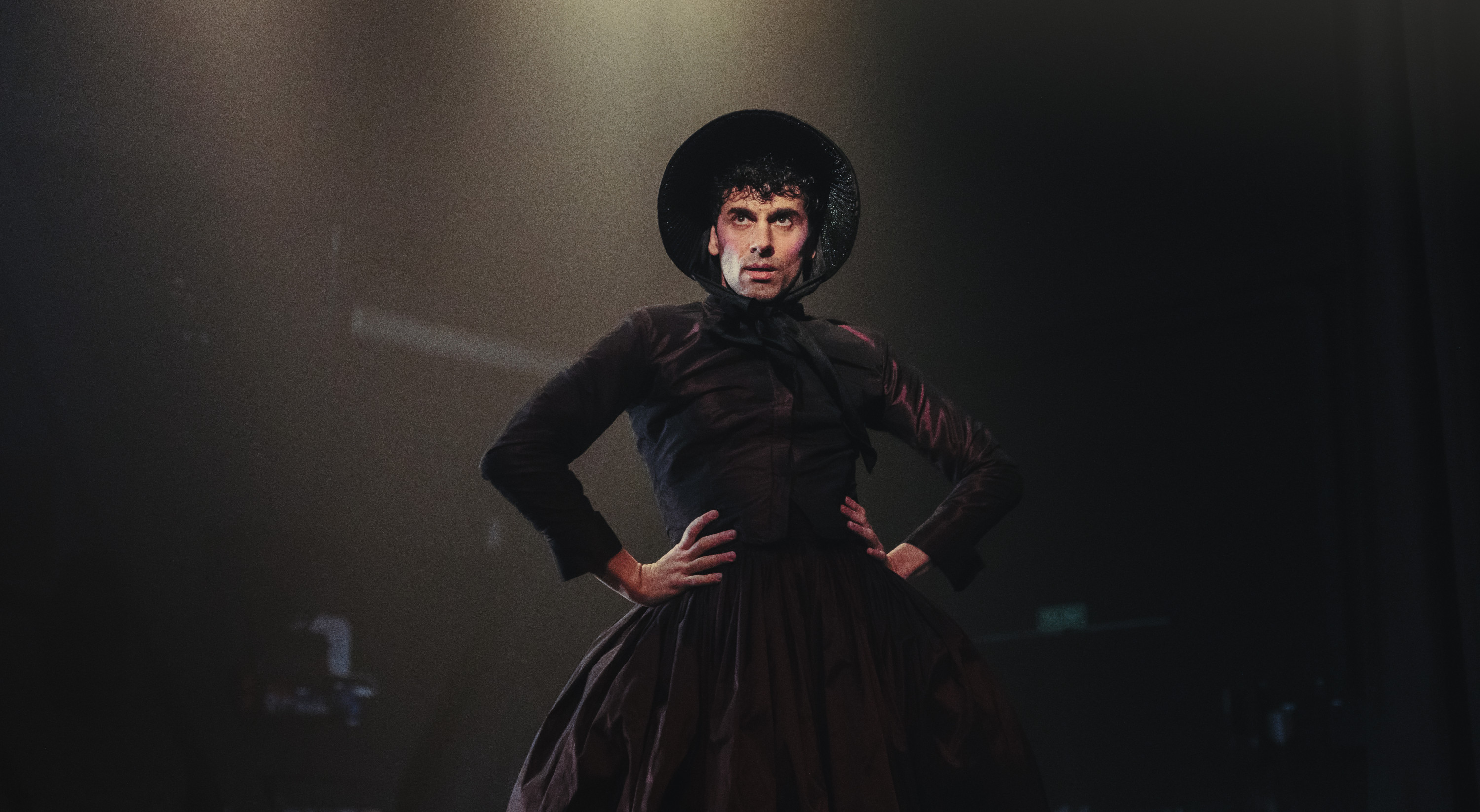
© Alejandra Amere ©

© Alejandra Amere ©

© Alejandra Amere ©

Metro : Bastille, Voltaire ou Bréguet-Sabin
Bus : 69 (Commandant Lamy), 61 (Basfroi)
Vélib' : 37 rue de la Roquette, 29 rue Keller, 169 avenue Ledru-Rollin, 9 rue Froment
Monday december 14
20h
Tuesday december 15
20h
Thursday december 17
20h
Friday december 18
20h
Saturday december 19
18h
Concept, dramaturgy, text, direction and performance Alberto Cortés. Lighting design and technical operation Benito Jiménez. Sound design and technical operation Óscar Villegas. Musical direction and violin Luz Prado. Guitar Adriano Galante. Choir and piano proyectoeLe. Technical coordination Cristina Bolívar. Surtitles Marion Cousin. Set design Víctor Colmenero Mir. Paintings Miguel Oliver. Costumes and touring production assistant Gloria Trenado. Hats Patricia Buffuna. Movement coaching Janet Novás. Outside eye Amalia Fernández. Photography Manu Rosaleny and Alejandra Amere. Video Johann Pérez Viera.
Production El Mandaíto Producciones SL
Coproduction Centro de Cultura Contemporánea Condeduque ; Kunstenfestivaldesarts ; Grec 2026 Festival Barcelona ; Festival d’Automne à Paris ; Théâtre de la Bastille ; Centre de les Arts Lliures de la Fundació Joan Brossa ; Agencia Andaluza de Instituciones Culturales—Teatro Central and Tanzquartier Wien
With the collaboration of Festival Citemor, CAMPO, Azala, Graner
The Théâtre de la Bastille and the Festival d’Automne à Paris are co-producers of this performance and present it in corealisation.
In the 19th century, a mysterious manuscript is found somewhere in the English countryside. A diary interwoven with poems, it is all that remains of Ester, who died from loving too much. In the shadow of this narrative, this new piece El corazón de Ester (The Heart of Ester) is the confession of a love and the exhaustion it results in.
One year after Analphabet, author, director and performer Alberto Cortés, from Spain, brings the audience, his faithful "Mi Lord" lover, an intimate confession, performed by a body which, like that of, Ester, is consumed by love, one which is “bigger than life itself and vaster than the sky”. Carried along by the female voices which have accompanied the creation of the show—that of the mystics Marguerite Porete, Emily Dickinson, the Brontë sisters, and Anne Carson, as well as Spanish philosopher María Zambrano –, he gives himself over to an exercise of progressive disappearance. Carrying out a form of literary transformism, both devout and queer, he exposes himself onstage, to such an extent that the body becomes worn away under the audience’s constant gaze. It becomes consumed by being consumed. And the show itself will also be destined to disappear, because this act of devotion will be of the limited-edition kind. Each representation will be numbered, from 1 to 50, a sort of pact of collective responsibility which is also a declaration of love aimed at the audience.

Metro : Bastille, Voltaire ou Bréguet-Sabin
Bus : 69 (Commandant Lamy), 61 (Basfroi)
Vélib' : 37 rue de la Roquette, 29 rue Keller, 169 avenue Ledru-Rollin, 9 rue Froment